
Top 10 Web Application Penetration Testing Services for different types of companies
image: istock/PeopleImages
The web application is usually the first spot for customer data, and this is why hackers check it every day. That’s where web application penetration testing services help. These services help teams fix weak spots by uncovering vulnerabilities early. Automatic scanning can miss high-risk issues that weaken security. The right penetration testing services will fill the gaps between automatic and manual testing.
The right tool will give precise findings and clean reports to ensure smooth workflows. However, the problem is getting bigger. Verizon’s 2026 report concludes that exploiting flaws is now responsible for 31% of initial access, while it used to be 20%. Web applications are still one of the most popular targets.
There are different service providers in the market. They differ in speed, price, and features. In this guide, we are going to compare the top 10 web application penetration testing services, so you can shortlist with confidence.
Web Application Penetration Testing Services Compared
We understand how difficult and crucial it is to choose the right security service. This table compares ten web application penetration testing services at a glance.
| RANK | PROVIDER | BEST FOR | KEY STRENGTH | PRICING |
|---|---|---|---|---|
| 1 | Cobalt | Teams that need a fast start | Credit-based testing platform | $3,500 promo test; others by quote |
| 2 | NetSPI | Large regulated firms | Deep manual testing at scale | Quote only |
| 3 | Bishop Fox | Big application portfolios | Expert testers plus Cosmos AI | Quote only |
| 4 | Synack | Federal and public buyers | FedRAMP Moderate platform | Published starts, plus platform fee |
| 5 | HackerOne | Teams with a bug bounty | Researcher community | Quote only |
| 6 | Bugcrowd | Fixed-scope tests | Tiered Pen Test as a Service | From $5,000 |
| 7 | NCC Group | Multi-region firms | Global consulting reach | Quote only |
| 8 | Rapid7 | Manual-led OWASP testing | Metasploit heritage | Quote only |
| 9 | Astra Security | Startups and small teams | Published per-target pricing | About $1,999 to $5,999 per target yearly |
| 10 | BreachLock | Mid-market budgets | Hybrid testing platform | Quote only |
You Might Also Like: Top 10 Access and Identity Management Software
What Is Web Application Penetration Testing?
Web application penetration testing services offer a systematic process of conducting attacks on your website or web app. The process involves ethical hackers who will attempt to exploit the weaknesses of the website, such as weak logins, and report back on how to fix the problem.
Good web application pentesting adheres to the principles of the Open Web Application Security Project (OWASP) Top 10. In it, broken access control still ranks first. Traditional companies conduct penetration testing as a one-time event, while modern companies offer Penetration Testing as a Service (PTaaS), which can provide live results and tests.
Vulnerability Assessment and Penetration Testing: What Is the Difference?
Vulnerability assessment and penetration testing (VAPT) are terms that are used together; however, they have different functions.
- A vulnerability assessment makes use of scanners to discover vulnerabilities. Although it is more efficient, it can produce many false positives.
- A penetration test relies on testers who may take advantage of vulnerabilities and demonstrate their actual consequences.
- Various web application security testing tools such as scanners and proxies can assist in both processes, but they cannot take the place of a tester’s judgment.
- VA relies on tools like Nessus, Qualys, and OpenVAS, while PT is performed using Burp Suite or Metasploit, as well as with the help of custom-made scripts.
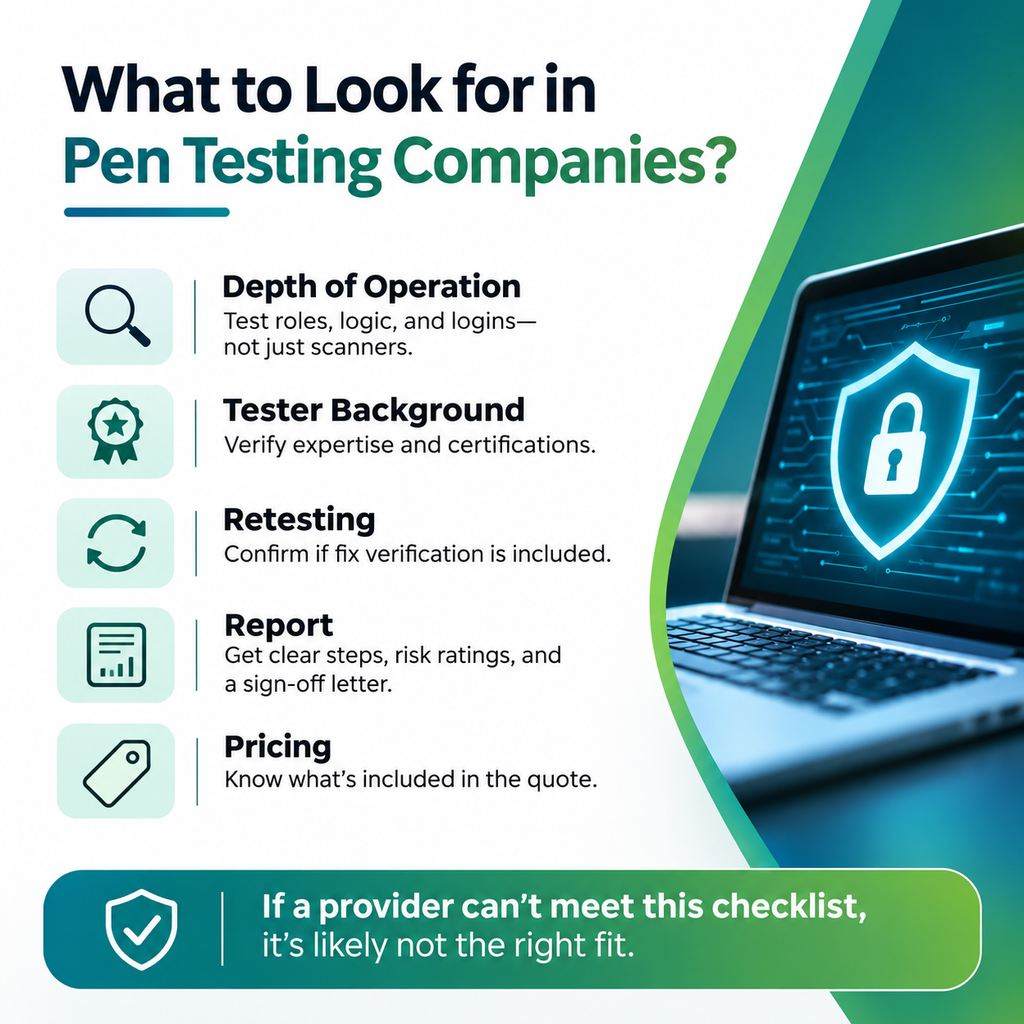
What to Look for in Pen Testing Companies?
Each vendor states that they are specialists in their field of testing, but there are differences in detail. Make use of the checklist below when comparing vulnerability assessment and penetration testing:
- Depth of operation: Testers should investigate business roles, logic, and logins. They should not only run scanners.
- Tester background: Ask for the expertise of pen testing consultants and proof of their industry certifications.
- Retesting: Find out if the vendor charges for rechecking the fixes.
- Report: Look for proof of steps and risk ratings. Check if the vendors offer a sign-off letter for auditors.
- Discovery of pricing: As most suppliers price according to the scope of work, make sure that you know what each quote includes.
If the provider’s service cannot pass the above checklist, it might not be the right fit for you. You don’t need shallow scanning. You need to test the paths that attackers might use in your product. And the findings should give a proper report that enhances your website’s security.
You may also like: Top Picks from the Best Zero-Trust Vendors
The 10 Best Web Application Penetration Testing Services
According to IBM’s 2025 report, the average cost of a data breach amounts to $4.44 million, which takes 241 days to discover and eliminate. Penetration testing helps you find and fix flaws before attackers use them.
We give the top rankings to web application penetration testing services that involve human testers who really know how to spot and verify all findings. Treat our rankings as a starting point, as the tools might suit you according to your needs.
#1. Cobalt
Best for: Teams that require a quick start for testing
Cobalt has assisted in promoting the PTaaS model. And it is one of the top users of it. To initiate, you can launch the tests, and the expert testers from the Cobalt Core community will run them.
It is one of the best web application penetration testing services for teams that want flexibility. The payment system is based on a credit-based mechanism where one credit equals approximately eight hours of testing. Cobalt also has a current offer in the form of the $3,500 Autonomous Pentest service.
Pros:
- Using credits facilitates testing over several applications
- The platform tracks findings and retests in one place
- Autonomous tests provide results within 24 hours
Cons:
- Team can change as the testers are freelancers
- Credits won’t roll over to a new contract
Official site: cobalt.io
#2. NetSPI
Best for: Large regulated firms
NetSPI has been a pioneer in PTaaS, claiming to have a team of more than 350 testers. Its web application penetration testing checks for all users, some of the OWASP Top 10 vulnerabilities, as well as business logic flaws.
NetSPI also offers continuous web app testing. This makes it one of the unique penetration testing service providers built for ongoing operations. Pricing is by quote.
Pros:
- Deep manual testing covers every user role
- Ongoing testing fills gaps between annual tests
- One platform tracks results across many assets
Cons:
- Enterprise sales cycles can feel heavy for small teams
- There is no public price list
Official site: netspi.com
#3. Bishop Fox
Best for: Enterprises with large app portfolios
Bishop Fox is a security company located in Tempe, Arizona. Through its Cosmos service, this company combines experts with an automated testing process. It also includes tests for the application features that are not publicly accessible.
In 2026, the company introduced Cosmos AI, which has made the testing process faster. According to the company, the first results appear within a few hours, and final outputs take up to five business days to produce.
Pros:
- Experts validate findings before you see them
- Live tester access and retesting support faster fixes
- Cosmos AI helps cover large app portfolios
Cons:
- The enterprise focus may exceed small-team budgets
- There is no public price list
Official site: bishopfox.com
#4. Synack
Best for: Federal and public buyers
Synack combines the AI tool, Sara, with its team of expert testers called the Synack Red Team. The team consists of more than 1,500 researchers. The platform is approved by the Federal Risk and Authorization Management Program (FedRAMP Moderate), which is extremely important for projects associated with the United States government.
The pricing starts at $4,000 for Sara’s machine-driven Pentest project and about $10,000 for a human-led test. The platform also charges an additional fee, so you must find the updated numbers.
Pros:
- Federal approval suits public buyers
- Researchers pass background checks
- Listed prices make early budgeting easier
Cons:
- The separate platform fee raises the total cost
- Testers come from a community pool so that the team can change
Official site: synack.com
You may also like: Top 10 Multi-Factor Authentication Software for Medium-Sized Enterprises
#5. HackerOne
Best for: Teams that already run a bug bounty
HackerOne provides pentesting as part of its services. So, customers can request to get their pentests redone or carry on with their bug bounty programs. That makes it a practical pick for the best web application and penetration testing services if you want testing and bounty programs together.
You’ll get all the findings on the platform after the testers report. You can also integrate it with Jira, Slack, and GitHub. However, the pricing is not public, so you will need to ask for a quote.
Pros:
- One platform covers pentests and bug bounty
- Retests are available during and after testing
- Findings arrive as researchers report them
Cons:
- Pentest pricing is not public
- The platform is best known for bug bounty, so compare pentest depth carefully
Official site: hackerone.com
You Might Also Like: Best Network Monitoring Software for Your Business
#6. Bugcrowd
Best for: Teams that want a fixed-scope test with pricing
Bugcrowd provides its testing service at three different levels: Standard, Plus, and Max. It takes around three working days for the Standard testing to commence and produce reports.
The Standard price for web application testing starts at $5,000 on AWS Marketplace. However, the more extensive the testing scope, the higher the cost of testing is. You can also compare prices for different web application penetration testing services.
Pros:
- Listed starting prices make budgets easier
- Fast launch fits tight deadlines
- Three tiers let you scale depth
Cons:
- A crowd model can mean different testers each time
- Retest terms vary by tier, so read the contract
Official site: bugcrowd.com
#7. NCC Group
Best for: Multinationals that want one method across regions
NCC Group is a publicly traded UK-based security consulting firm with a footprint spanning the globe. Its pen testing consultants apply one methodology globally. The service looks for logical errors and vulnerabilities connected to other apps and technical areas.
However, that comes with consulting-style pricing, and rates don’t appear to be disclosed. Always request the names of testers in the statement of work, because it may vary significantly across the board.
Pros:
- Global delivery suits multi-country programs
- A public company eases vendor checks
- Years of public research build trust
Cons:
- Consulting-scale pricing can be high for small teams
- Lead times may be longer than with self-serve platforms
Official site: nccgroup.com
#8. Rapid7
Best for: Teams that want manual testing from a known vendor
Rapid7 offers pentesting alongside its security tools. Its web application tests follow OWASP best practices and put a lot of emphasis on manual labor. The work can include access control, logins, and sessions. The service offers in-depth integrations between pentest results and the insight platforms.
The broad service offers comprehensive security from a single vendor. One vendor will be doing the testing, monitoring, and response. Rapid7 also runs Metasploit, a well-known hacking toolkit. Pricing is via quote.
Pros:
- Manual tests follow OWASP best practices
- The testers use their Metasploit skills
- Current Rapid7 customers get a known vendor
Cons:
- Pricing is not public
- It is a broad vendor, so team depth may vary
Official site: rapid7.com
#9. Astra Security
Best for: Startups and small teams
Astra Security combines automated scans and manual penetration tests in a single package. Its pricing is one of a kind for web application testing companies. In terms of third-party reviews, plans cost anywhere from $1,999 to $5,999 yearly for each target.
Astra is also claiming certification from the Council of Registered Ethical Security Testers (CREST). Moreover, its dashboard combines application security testing with expert support.
Pros:
- Transparency in pricing helps budgeting
- Scanning and manual testing share one dashboard
- The public certificate helps with customer reviews
Cons:
- Each plan covers one target, so costs rise with more apps
- Some users find the pricing steep
Official site: getastra.com
#10. BreachLock
Best for: Mid-size teams that want hybrid testing
BreachLock utilizes a hybrid model. It uses a combination of manual and automated testing methods. It performs a mix of manual and automated testing methods. The staff comprises qualified and certified testers who apply testing practices according to the standards defined by the OWASP Top 10.
The cost of its services depends on the scale and frequency of the testing conducted. No indication of the pricing is made publicly available. Their PTaaS service page promises unlimited retesting, though the pricing packages make it clear that there are certain limitations regarding the retesting procedures.
Pros:
- In-house testers keep quality steady
- A hybrid model can cut lead times
- The platform tracks findings and rescans
Cons:
- Pricing is not public
- Retest terms differ by tier
Official site: breachlock.com
Which Pentesting Service Fits Your Business?
These examples show how to match web application penetration testing services to your setup:
- Startups on a budget: Astra Security or Bugcrowd.
- Large regulated firms: NetSPI or Bishop Fox.
- Federal and public work: Synack.
- Teams with a bug bounty: HackerOne.
- Global firms: NCC Group or Rapid7.
Use these matches as a starting point. Shortlist two vendors and compare scope, retest terms, and sample reports.
You Might Also Like: Top 10 Malware Protection Software for Businesses
Final Takeaway
Making the correct decision for web application penetration testing services is contingent upon your app, budget, and audit timeline. Startups may start with Astra or Bugcrowd. Large companies need to make comparisons between NetSPI and Bishop Fox. Before proceeding, it is essential to ask for a sample report and obtain names of testers.
Frequently Asked Questions
Usually, a test takes between one and three weeks depending on the extent of the test. However, with the use of AI, it is possible to receive the results quickly, sometimes within hours or a few days.
Not really, because these two processes are not the same. While a vulnerability scan is performed automatically, a pentest includes the presence of human testers who can use attacks to provide their clients with insights as to how serious the vulnerability can be.
For any web application, a testing process should be conducted at least once a year and whenever a major change is applied to the application. This will offer real-time alerts and improved security with time efficiency.