

Easy-to-Use E-commerce Website Builders for Beginner Store Owners 2026
Building an online store from scratch can seem confusing and time-consuming, but it can be a great way to grow your business, made possible with a website builder. A professional-looking website displaying your products clearly, accepts payments, and makes order management easy is important.
Even if you have no coding experience, you can utilize an e-commerce website builder to handle these tasks for you. Check out these 10 AI e-commerce website builders if you want to get your store online quickly and sell with less effort.
We Handpicked the 10 Best Website Builders
We tested every platform on the following criteria that are most important when creating and operating an online store:
- Pricing and fees: Monthly subscription fees, transaction fees, payment processing, hosting, paid extensions, premium features.
- Ease of use: The ease of the platform to set up, manage and use without advanced technical skills.
- Design flexibility: How much control you have over how your store looks, how it is laid out, and its overall design.
- Product capacity: The number of products that can be listed and whether the platform can accommodate an expanding product catalog.
- In-built e-commerce capabilities: Whether important selling tools are built-in or need extra apps and extensions.
- Marketing and SEO: Features such as abandoned cart recovery, social selling, email marketing, analytics, and search optimization.
- Scalability: How well each platform can handle more products, sales channels, customers, and team members as a business grows.
Website Builders for E-commerce at a Glance
| Builder | Starting Price | Payment Gateways | Best For |
| Shopify | $39/ monthly / $29/per month yearly | 100+ third-party providers | Businesses focused on e-commerce growth |
| Hostinger Website Builder | $3.99/month for unlimited plan with ecommerce features | 100+ payment methods | Beginners building affordable online stores |
| BigCommerce | $39/ monthly / $29/per month yearly | 65+ pre-integrated solutions | Growing stores with complex needs |
| Wix | $29.77/monthly | 100+ providers | Small businesses wanting easy store creation |
| Squarespace | $25/ monthly / $19/per month yearly | Squarespace Payments, Stripe, PayPal, Square | Design-led brands selling online |
| Webflow | Free / $15 per month yearly | Stripe and PayPal | Brands needing highly customized storefronts |
| Square Online | Free / $49/month Plus / $149/month Premium | Square Payments | Businesses combining online and POS sales |
| GoDaddy Airo | $20.99/per month yearly | GoDaddy Payments, Stripe and Credit cards | Beginners wanting fast store setup |
| Shift4Shop | $41/month | 100+ providers | Stores needing extensive e-commerce features |
| Volusion | $35/month | Volusion Payments Powered by Stripe, PayPal, Authorize.net, NMI | Businesses wanting hosted e-commerce tools |
Big Players in Ecommerce Website Builders
A few platforms have become major names in the ecommerce website builder market. One of the most popular choices is of course Shopify, which offers a specialized platform for creating and running online businesses.
Wix offers a visual website builder and ecommerce functionality, making it easier for small businesses to build a store without too much technical expertise. Further, BigCommerce offers the following features: product management, checkout, payments, marketing, and multichannel selling.
While these platforms share similar ecommerce capabilities, they have different methods of creating an online store. Shopify is all about ecommerce operations, Wix is more about creating and designing a website easily, and BigCommerce is more about a wide range of built-in tools for businesses with more complex ecommerce needs.
Easy-to-Use E-commerce Website Builders 2026 Update
Let’s check out the ten best e-commerce website builders that new businesses should look into:
1. Shopify
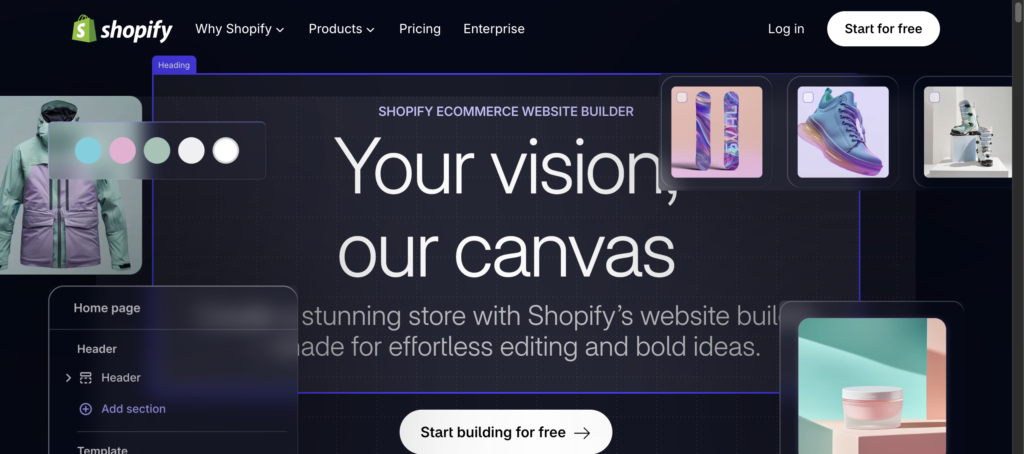
Shopify is a full-fledged e-commerce solution for companies seeking a hosted store with a wide range of selling capabilities and integrations.
- Price: Basic is $29/month (annual) or $39/month (monthly)
- Design: 200+ themes, customizable templates, and a fully-featured online store editor through
- Payments: Supports 100+ third-party payment providers, and Shopify Payments is available in supported markets with multi-currency capabilities
- SEO & marketing: Contains several sales channels, inventory tools, analytics and marketing features
- AI tools: Shopify offers an AI assistant and content creation and management tools
- Selling channels: Supports marketplaces, social commerce, in-person sales, and AI shopping channels through its e-commerce features
Pros:
- Unlimited products and several selling channels
- A large app ecosystem and built-in AI tools
Cons:
- Third-party transaction fees may apply
- Premium themes and apps can add to costs
Best for: Companies looking for an all-in-one e-commerce solution and droppingshipping online platform that can grow.
2. Hostinger Website Builder

Hostinger Website Builder combines website creation and ecommerce tools with drag-and-drop editing and AI features, making it possible to launch an online store without coding.
- Price: Premium costs $2.99/month, Unlimited $3.99/month, and Cloud Startup $7.99/month on 48-month plans. Unlimited and Cloud Startup include ecommerce features
- Design: Offers 400+ templates, drag-and-drop editing, and customizable layouts for online stores
- Payments: Supports 100+ payment methods, including options such as Stripe and PayPal, depending on the market
- SEO & marketing: Includes SEO tools, analytics, email marketing, and integrations for growing your store
- AI tools: Can generate websites, product descriptions, images, and other store content with AI
- Store management: Supports products, inventory, orders, shipping, discounts, gift cards, and product reviews via its website builder
Pros:
- Easy setup with AI-assisted website creation.
- Ecommerce and website-building tools are available in one platform.
Cons:
- Fewer advanced ecommerce features than dedicated platforms such as Shopify.
- Some ecommerce capabilities are tied to specific plans.
Best for: Beginners and small businesses that want an affordable website builder with ecommerce tools..
3. Wix
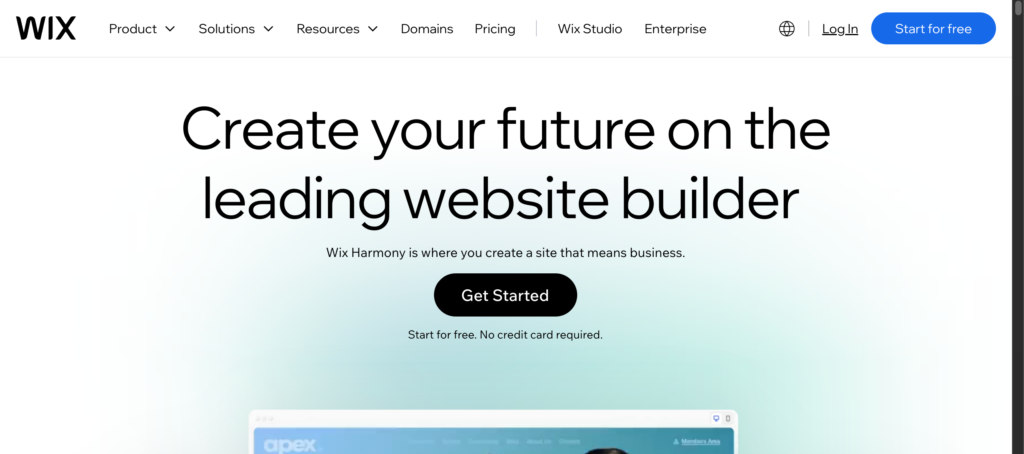
Wix is an e-commerce platform that also offers a visual website builder, allowing you to build a store without coding.
- Price: Offers Core at $29/month, Business at $39/month, and Business Elite at $159/month
- Design: Customizes pages, layouts, product displays and storefronts using a visual editor.
- Payments: Offers 100+ payment providers worldwide, with payment options and supported currencies varying by country and provider
- SEO & marketing: Abandoned cart recovery, back-in-stock notifications, marketplace, and social selling.
- Store features: Supports physical and digital products, subscriptions, variants, and multichannel inventory.
- Customization: Velo and APIs allow developers to add custom functionality and integrations through its ec-ommerce features
Pros:
- Easy visual website editor
- Built-in marketing tools and large product limits
Cons:
- Higher plans are needed for advanced features
- If the store is larger, it might require more applications
Best for: Small businesses and first-time sellers looking for a visual builder.
4. BigCommerce
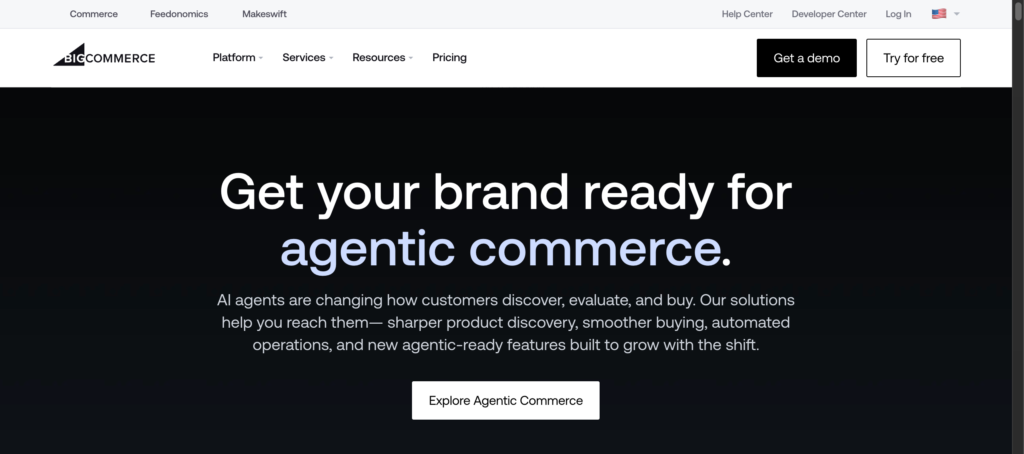
Some third-party apps are not necessary with BigCommerce because it offers a variety of e-commerce capabilities directly in its platform.
- Price: Core costs $39/month, Growth at $105/month, Scale at $399/month, and Performance from $1,499/month
- Design: Responsive storefronts with customizable e-commerce themes
- Payment gateways: Supports over 65 pre-integrated payment gateways operating across more than 150 countries and 140 currencies
- SEO & marketing: Product management, promotions, reporting, and various sales channels
- B2B tools: Supports customer groups, custom pricing, and account-based purchasing
- Storefronts: Supports multiple storefronts for different brands, regions, or product lines with BigCommerce’s product features
Pros:
- A lot of ecommerce functionality is included
- Accepts various payment methods and channels
Cons:
- Open Payment Provider fees may apply
- Plan upgrades can be triggered by sales thresholds
Best for: Stores that wish to add more features to the platform
5. Squarespace

Squarespace is a website builder that is also e-commerce-friendly, which is ideal for businesses that prioritize design and branding.
- Price: Offers Basic at $19/month, Core at $29/month, Plus at $49/month, and Advanced at $99/month
- Design: Provides professionally designed templates and visual editing tools
- Payments: Supports Squarespace Payments, Stripe, PayPal, and Square, with supported countries and currencies depending on the payment processor
- SEO & marketing: SEO controls, blogging, analytics, email marketing, and promotional tools
- Product presentation: Supports product videos, reviews, categories, related products, and rich product pages
- Selling options: Supports physical products, digital products, memberships, services, and subscriptions through its ecommerce features
Pros:
- Professional templates and good design
- Higher plans have 0% online store transaction fees
Cons:
- The basic plan has a 2% online store transaction fee
- Fewer extensions than bigger e-commerce platforms
Best for: Brands looking for a sleek e-commerce website.
You Might Also Like: Top 10 Domain Registrars for Small Businesses
6. Webflow
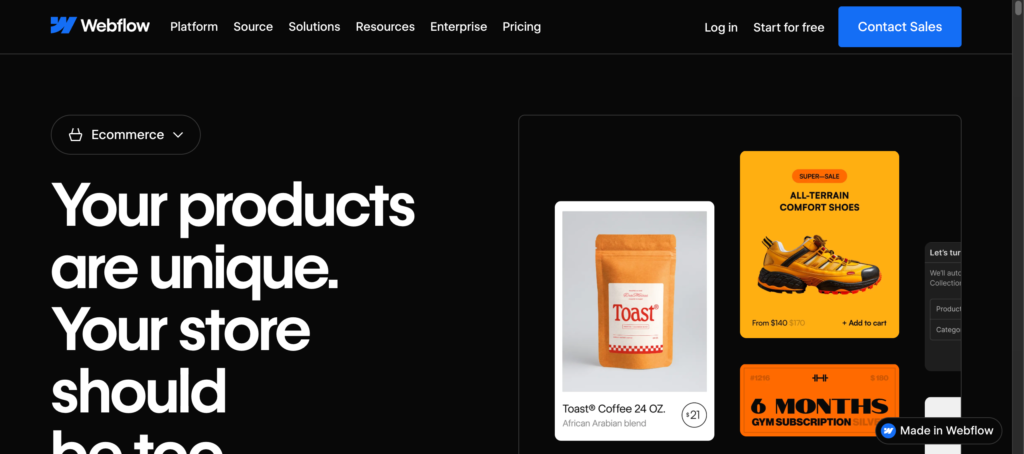
Webflow provides users with a high level of control over how websites are designed and how e-commerce stores are laid out, and it keeps the store within its visual development platform.
- Price: Standard costs $29/month, Plus $74/month, and Advanced $212/month when billed yearly for e-commerce plans
- Design: Offers comprehensive control of storefronts, product pages, carts, and checkout
- Payments: Webflow Ecommerce natively supports Stripe and PayPal, with Stripe supporting 135+ currencies and PayPal covering 200+ markets
- SEO & marketing: Includes customizable page structures, CMS content, SEO controls, and analytics integrations
- Store capacity: Plans can accommodate 500, 5,000 or 15,000 e-commerce products
- Development: APIs and integrations allow developers to build custom e-commerce experiences with Webflow Ecommerce
Pros:
- Very good design of the storefront
- Webflow’s transaction fee is waived with higher plans
Cons:
- Standard plan has a 2% transaction fee
- Learning curve is higher than simpler builders
Ideal for: Designers and brands that require a very customised storefront.
- Square Online
Square Online integrates e-commerce with Square’s point-of-sale solution, which is beneficial for companies that sell both online and offline.
- Price: Provides a free plan along with paid ones which includes Plus at $49/month,and Premium at $149/month
- Design: Offers an easy-to-use editor to build online stores and product pages.
- Payments: Square payment processing is available, with each seller processing payments in their account’s local currency
- SEO & marketing: Includes built-in SEO tools, customer accounts, product reviews, and abandoned cart emails.
- Inventory: Synchronizes inventory between online stores and Square’s in-person sales system.
- Selling options: Supports pickup, local delivery, shipping, payment links, and POS sales through its online store features
Pros:
- Free plan available
- Links online and offline sales
Cons:
- Advanced features are available on paid plans
- Payment is available in different countries
Best for: Companies that have already integrated Square into their in-person sales process.
8. GoDaddy Airo
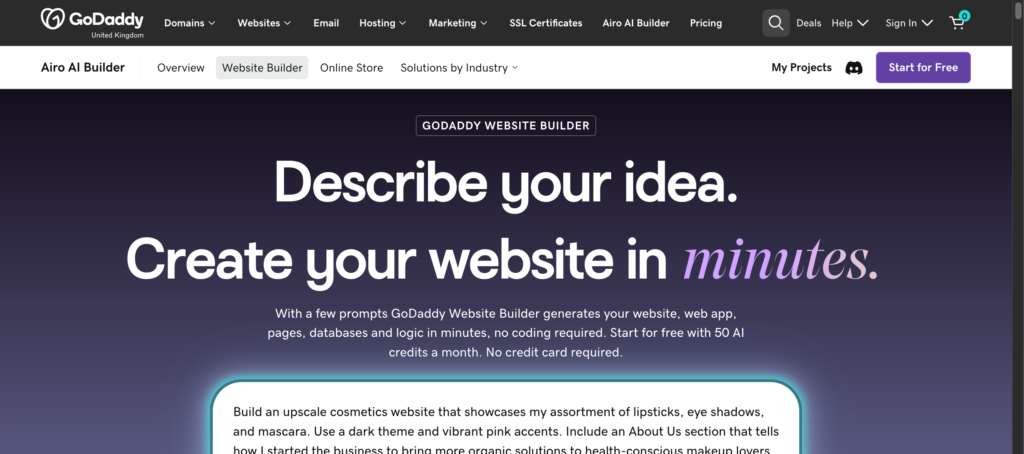
GoDaddy Airo is designed to make it easy for small businesses to set up their websites and e-commerce stores with the help of AI-powered tools.
- Price: GoDaddy’s Commerce plan currently costs $20.99/month with an annual plan
- Design: Airo can create a website based on a description of your business
- Payments: GoDaddy Payments is available to businesses in the U.S. and Canada, with payment methods and supported currencies tailored to each market
- SEO & marketing: Contains SEO features and tools for creating and managing website content
- Shipping: Supports dynamic shipping calculations, local delivery, pickup, and shipping labels
- Store management: Lets you manage products, orders, and inventory from one dashboard with GoDaddy’s Online Store features
Pros:
- AI can help to speed up the initial setup of the website
- Integrates domains, hosting, website, and e-commerce
Cons:
- Fewer design controls than advanced builders
- The exact price will depend on the market and promotion
Best for: Quickly launching a store with AI assistance for small businesses.
9. Shift4Shop
Shift4Shop is an e-commerce platform that is hosted and offers unlimited products on its current paid plans.
- Price: Basic costs $29/month, Plus $79/month, and Pro $229/month
- Design: Mobile ready themes and customizable e-commerce storefronts
- Payments: Integrates with 160+ payment providers, including Shift4, PayPal, Stripe, Square, and Visa, with international payment support
- SEO & marketing: Includes abandoned cart recovery, email marketing, coupons, loyalty tools, affiliate features, and reviews
- Operations: Includes shipping tools, inventory controls, order management, CRM, and returns
- Sales channels: Supports Amazon, eBay, Google, Facebook, dropshipping, and POS integrations through its full e-commerce features
Pros:
- Paid plans come with unlimited products
- No additional transaction fees on paid plans
Cons:
- Free End-to-End plan is U.S. only
- The higher plans are much more expensive
Best for: Merchants looking for unlimited products without additional platform transaction fees.
10. Volusion
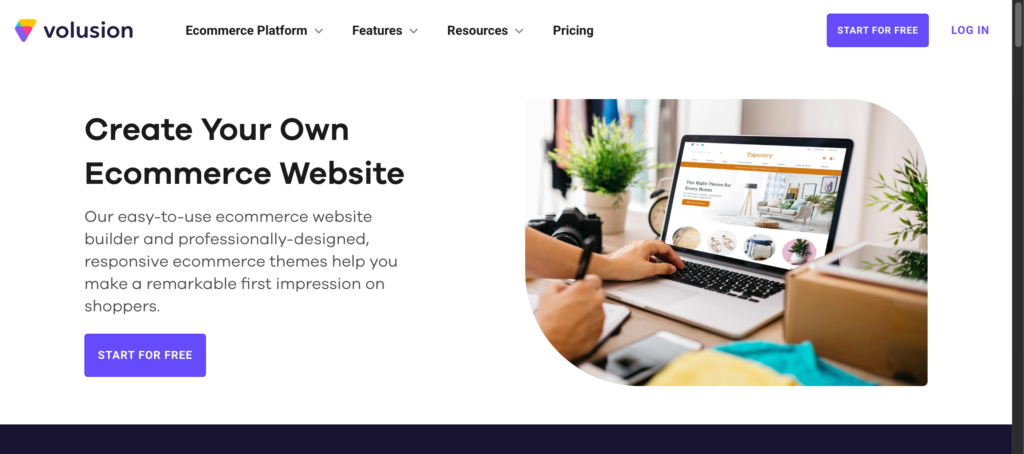
Volusion is a hosted online store solution that provides e-commerce store management, product tools, hosting, and various plans for expanding businesses.
- Prices: Personal $35/month, Professional $79/month, and Business $299/month
- Design: Offers customizable storefronts and product pages
- Payments: Supports Stripe, PayPal, Authorize.net, and NMI, with Stripe offering 135+ currencies across 35+ countries
- SEO & marketing: Includes editable metadata, SEO-friendly URLs, sitemap controls, abandoned cart messaging, and discount tools
- Store management: Supports product variants, subscriptions, gift cards, returns, customer accounts, and order management
- Hosting: Includes hosted infrastructure, SSL, unlimited bandwidth, and PCI-compliant hosting through its features
Pros:
- Hosted platform with hosting and SSL included
- The higher plans are designed to accommodate more catalogs and sales
Cons:
- Personal plan has a maximum of 100 products
- The more expensive plans are for larger stores
Best for: Companies seeking an e-commerce solution that includes store management features and is hosted
Shopify vs. Wix vs. Squarespace Comparison
Shopify, Wix, and Squarespace are popular platforms, but they differ in their focus and features. Shopify is primarily for ecommerce; Wix offers an easy way to design a website without coding for selling online, whereas Squarespace focuses more on design and branding. The table below compares their key features, pricing, product limits, and payment options.
| Feature | Shopify | Wix | Squarespace |
| Main focus | Ecommerce-first platform | Website builder with ecommerce | Design-focused website builder |
| Store management | Advanced inventory, orders, products, and fulfillment tools | Simple store and inventory management | Straightforward product and order management |
| Product selling | Physical, digital, subscriptions, and more through apps | Physical and digital products with additional selling options | Physical, digital products, services, and memberships |
| Customization | Extensive themes and ecommerce customization | Flexible drag-and-drop editing | Strong templates and visual customization |
| Marketing | Advanced marketing, analytics, social, and marketplace selling | Built-in marketing and customer engagement tools | Strong content, blogging, email, and brand-focused marketing |
| AI capabilities | AI assistant and AI-powered store content tools | AI website creation and content generation | AI-assisted website and content creation |
| App ecosystem | Very large e-commerce app ecosystem | Large app marketplace | Smaller extension ecosystem |
| Scalability | Suited to small stores through large e-commerce operations | Better suited to small and growing businesses | Well suited to smaller, design-led stores |
How to Choose the Best Website Builder for Your Ecommerce Store
The best website builder for your online store is the one that suits your needs. Consider these factors when deciding:
- Review the price: Monthly plan, transaction fees, payment processing, apps and other extra fees.
- Consider your product catalog: Ensure the platform supports your current product volume and future expansion.
- Look at ease of use: Select a builder based on your technical expertise and the amount of setup you are willing to do.
- Compare design flexibility: See if you can make changes to your store’s design, product pages, checkout, and branding.
- Check e-commerce capabilities: Check if there are any payment, inventory, shipping, discount, order and customer management tools built in.
- SEO and marketing features: These include SEO controls, email marketing, abandoned cart recovery, analytics, and social selling.
- Integrations: Ensure the platform is compatible with your payment gateways, shipping providers, marketplaces, and other tools.
- Consider scalability: Select a platform that will support additional products, orders, customers and team members as your business expands.
Our Recommendations
There is no one best e-commerce website builder, as it will depend on the size of your catalog, how much design control you want, and how much you are willing to pay in ongoing fees.
Shopify is the best option for general use, WooCommerce is the best option for low fees at scale, and GoDaddy Airo or Webflow is worth considering if you’re looking for AI assistance with setup and design.
Either way, before you make your final decision, make sure to look at the actual renewal price and transaction fee, as this is where the real difference in costs will be seen over time.
Frequently Asked Questions (FAQs)
Can I switch e-commerce website builders after launching my store?
Yes. You can move an online store to another platform. You will also need to recreate parts of your store design and reconnect third-party services. Before switching, check what data your current platform allows you to export.
Do I need coding skills to build an e-commerce website?
No. Most of the modern e-commerce website builders offer visual editors, templates, and guided setup tools that enable you to build a store without coding.
Can I use my current domain name with an e-commerce website builder?
Yes. The majority of e-commerce platforms will enable you to link your domain name that you already own. Typically, you must change your domain’s DNS records to direct it to the new store.
What if I cancel my plan, what will happen to my e-commerce website?
The cancellation policy of the platform determines your store’s access and functionality. Some services might turn off the store after the paid time or some might maintain some features of the website. Export important store data before canceling and confirm for how long wil your information be available.
Can e-commerce website builders handle international sales?
Many can offer international selling with features like multiple currencies, localized payment methods, international shipping, and tax settings. But the choices will vary based on the platform, your business location, payment provider and the countries you wish to sell to.